
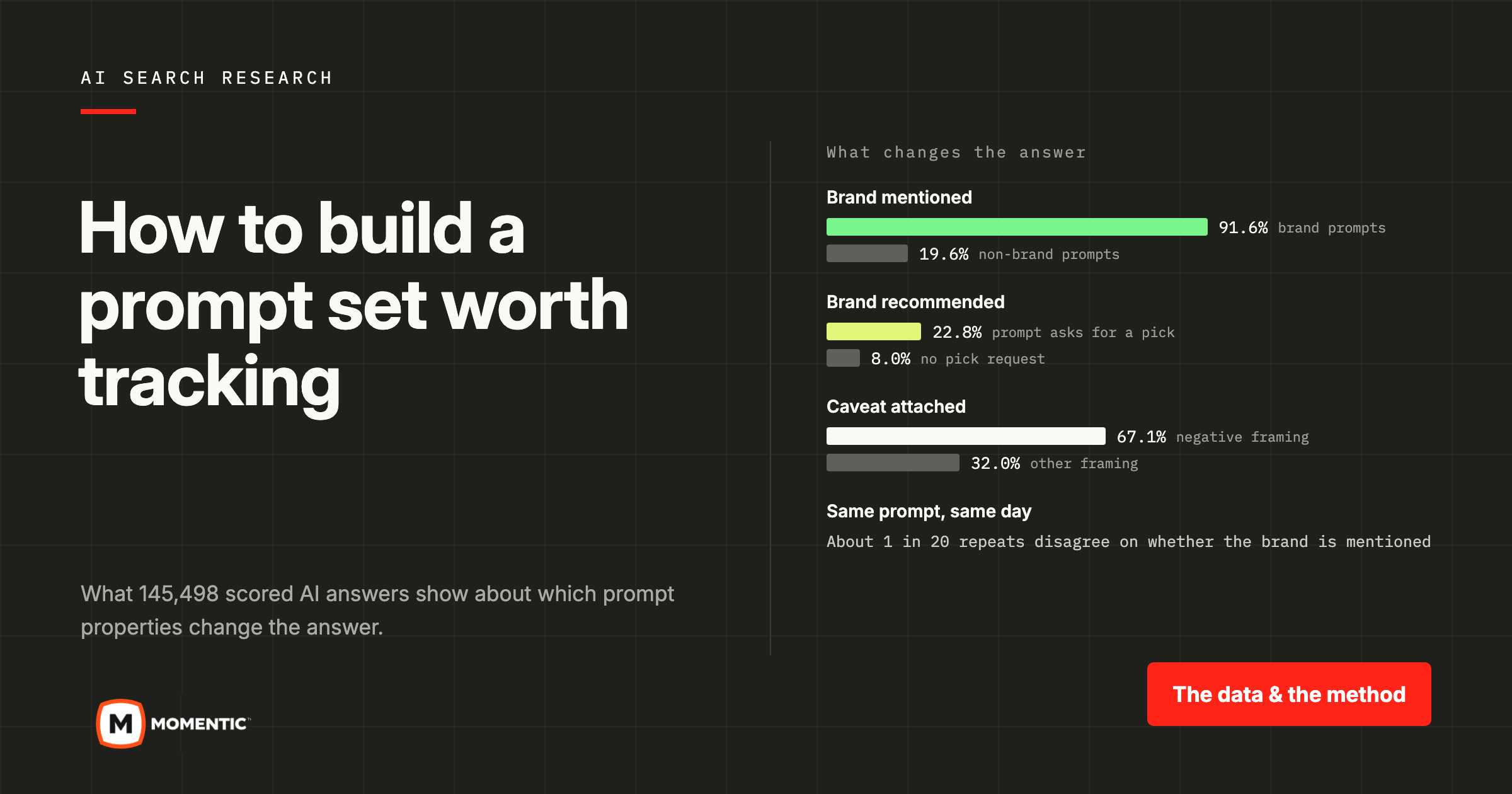
Prompt tracking means sending ChatGPT, Gemini, Perplexity, Claude, and other AI assistants the same prompts on a schedule and recording three things about each answer: whether it mentions your brand, whether it cites your pages, and whether it recommends you. Advice on writing those prompts, such as hitting a target character count or testing each prompt a few times by hand, rarely comes with data behind it. We measured which properties of a prompt change the answers.
Between July 13 and August 15, 2026, Atlas, Momentic's AI answer tracking platform, ran 8,342 prompts for 18 brands across 11 answer surfaces: ChatGPT, Claude, Gemini, Perplexity, Google AI Overviews, Google AI Mode, Bing Copilot, Google Search, and the no-search API modes of ChatGPT, Claude, and Gemini. The platforms returned 156,233 answers, and Atlas scored 145,498 of them. For each scored answer, Atlas records whether the answer mentions the brand, which other options it mentions, which sources it cites, its sentiment toward the brand, and any caveats about the brand. A caveat is a warning or qualification the answer attaches to the brand. The findings below come from those 145,498 scored answers, and the method at the end follows from them.
Brand prompts and non-brand prompts need separate reporting
Brand prompts include the brand's name, such as "Would you recommend [brand]?" or "Is [brand] legit?". Answers to brand prompts mentioned the brand 91.6% of the time (57,824 answers). Answers to non-brand prompts mentioned the brand 19.6% of the time (87,674 answers). An average of the two rates describes neither kind of prompt. Report brand prompts as their own group, and keep them out of the headline mention rate.
Answers to brand prompts are still worth reviewing one by one. In 8.4% of answers to brand prompts, the answer did not mention the brand the prompt asked about. That rate varies by brand. Across the 16 brands with at least 200 scored answers each, the median brand was mentioned in 95.7% of answers to its brand prompts. The lowest was mentioned in 66.5%.
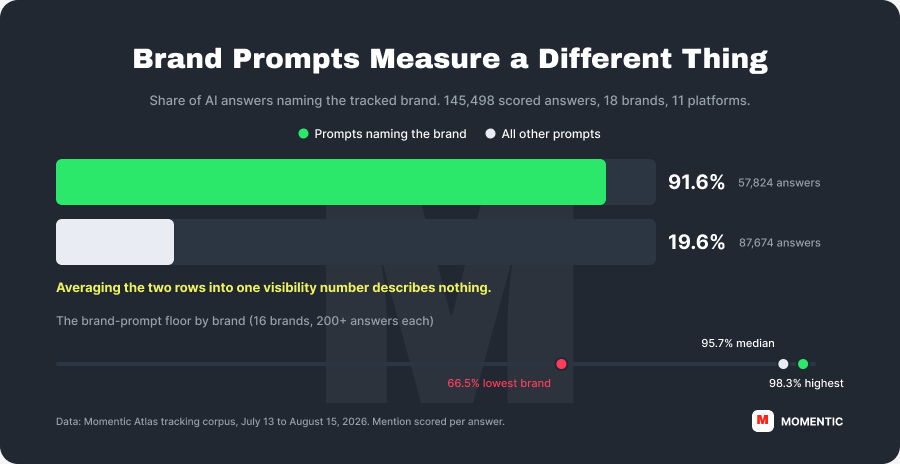
The brand at 66.5% shows what can go wrong. It is a services firm whose name is also a common industry phrase, comparable to an agency called Precision Marketing. Asked "Are there any downsides or risks to using [the brand]?", the assistants described the risks of the marketing approach that shares the firm's name and did not mention the company. Its comparison prompts failed the same way. One assistant replied that the comparison made no sense, because "you don't choose between a strategy and an agency." About a third of the answers to this brand's own prompts describe the concept instead of the company. Publishing more content is unlikely to change that until the firm resolves the confusion between its name and the industry term. When a brand prompt's mention rate drops this far, that result belongs at the top of the report.
Asking for a recommendation changes the answer more than prompt length does
A claim we hear often is that tracked prompts should run 180 to 210 characters. Few prompts in our corpus run past 200 characters, so we cannot test that range directly. We can test what the extra length is supposed to produce: answers that mention several options and recommend one. In our data, the request in the prompt produces that result, and the effect is large.
Non-brand prompts that ask for a pick, such as "what would you recommend," "best X for Y," or "which should I choose," produced answers that mentioned 4.55 options on average (24,225 answers). Non-brand prompts that ask about the topic without asking for a pick produced answers that mentioned 1.25 options on average (63,455 answers). With brands and platforms held constant, answers to pick prompts recommended the tracked brand 22.8% of the time. For prompts without a pick request, the rate was 8.0%. An answer that recommends nothing cannot show whether you are the recommendation.
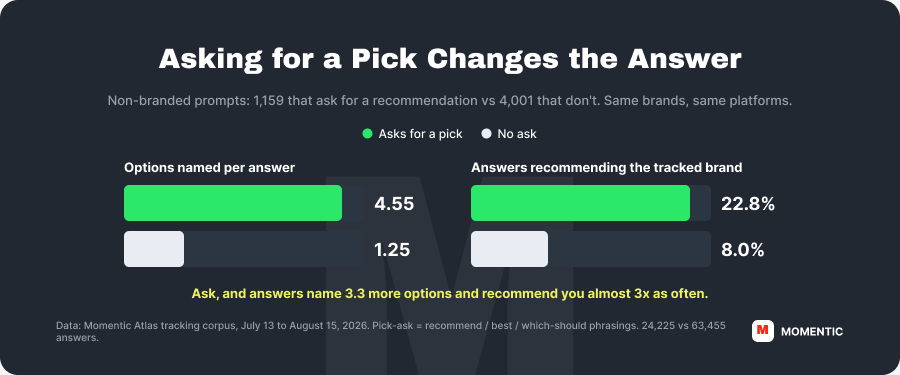
Momentic's tracking of its own brand shows the difference. Answers to "Best alternatives to [a well-known competitor]" mentioned 12.5 options on average across 51 runs. Answers to "What KPIs should an SEO agency report on each month?", a prompt based on a real buyer question that we also track, mentioned no options across 50 runs. Each prompt supports a different measurement. The first measures whether assistants recommend Momentic. The second measures whether Momentic's published thinking appears in the explanation. Combining the two into one visibility number hides which of them changed.
Length advice partly works because longer prompts tend to include more context. A useful prompt includes four parts: who is asking, their situation, the specific problem, and the request. Those four parts usually take a sentence or two. Check that each prompt includes all four, and let the character count follow from them.
Short prompts have a separate use. Category prompts under 40 characters, such as "best [category]," produced answers that mentioned 2.68 options on average. Those answers mentioned the tracked brand 30.4% of the time. Answers to mid-length prompts mentioned it 17.3% of the time. Short prompts do not simulate a buyer. Their answers show whether assistants already list your brand among the defaults in your category, so a few of them belong in the set as a category check. A set made mostly of short prompts behaves like a keyword list and says little about what buyers ask.
A common objection to long prompts is that nobody types 200 characters into ChatGPT. That is often true of a single message. A buyer usually describes their situation and asks follow-up questions over several messages before asking which option to choose, so by the time they ask, the assistant has that context from earlier in the conversation. Tracking tools send one message, so the prompt has to include that context along with the request. The prompt simulates the last message of the conversation, the one where the buyer asks for a decision.
Identical prompts disagreed on brand mentions in about 1 in 20 same-day repeats
Atlas runs many prompts several times per platform within the same run. A repeat group is the same prompt on the same platform on the same day. Across 29,344 repeat groups, the answers within a group disagreed on whether they mentioned the brand 4.5% of the time for non-brand prompts and 5.1% of the time for brand prompts.

That rate changes how to read tracking data. One anonymized example from the corpus: Atlas ran "What is the best car wash in [a mid-size Western city]?" three times on Perplexity in one run. The first answer did not mention the tracked brand, and the second and third did. A brand that appears in one week's report and disappears from the next may be showing this same-day variation, which occurs in about one repeat group in twenty. A single test of a prompt says little about how its answers will behave, and week-over-week changes based on single runs can be noise.
The variation extends past brand mentions. In a separate experiment, we sent one prompt to Gemini with search grounding ten times and recorded the query fan out behind each answer, meaning the searches Gemini ran before it answered. No single search string appeared in all ten runs, and 86.8% of the strings appeared in only one run. The topics those searches covered were the same in all ten runs: the same entities and the same attributes, worded differently each time. Gemini was consistent in what it checked and inconsistent in how it worded the searches. In every experiment we have run, the exact search strings changed between runs and the topics stayed the same. Judge prompts, and read reports, at the topic level.
In practice, run each candidate prompt several times, keep the prompts whose answers are consistently relevant and sourced, and avoid conclusions based on a single run.
Negative prompt framing doubled the caveat rate
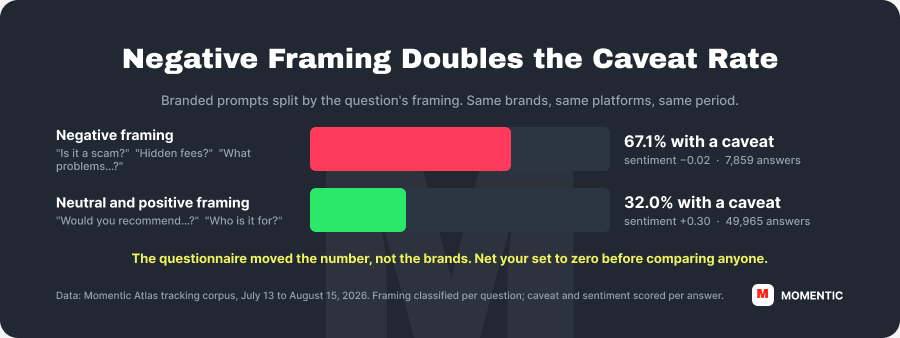
We split brand prompts by framing. Negative prompts ask about problems, such as "Is [brand] a scam?", "Are there hidden fees?", or "What problems do people have with [brand]?". We compared them with all other brand prompts.
Answers to negative prompts attached a caveat to the brand 67.1% of the time, and their average sentiment toward the brand scored slightly negative (7,859 answers). Answers to the other brand prompts attached a caveat 32.0% of the time, and their average sentiment scored clearly positive (49,965 answers). The brands, platforms, and dates were the same. Negative framing roughly doubled the caveat rate and turned average sentiment from positive to negative.
Assistants answer the prompt they are given: asked about problems, they list problems. Three anonymized examples show the pattern. "Are there any hidden fees with [brand]?", asked about a live-events venue, returned an itemized list of every surcharge the assistant could find. "Is [brand] worth the price?", asked about a specialty lighting manufacturer, returned an answer that praised the products and added a caveat that prices can run higher than mass-market alternatives. "Did [brand] raise its prices recently?", sent to an assistant with no browsing and no pricing data, returned a non-answer about pricing uncertainty, which also scores as a caveat. Some of these caveats are accurate. The venue's fees are real.
The measurement problem appears in the totals. A prompt set weighted toward negative prompts shows about twice the caveat rate of a balanced set, whichever brand it measures. When a report compares a negative-leaning set for one brand with a balanced set for another, the gap in caveat rates comes from the prompt sets and says nothing about the brands.
Two rules follow. First, classify each prompt's framing as negative, neutral, or positive before it enters tracking, and balance the set so the framing nets to roughly zero, especially in any set used to compare brands. Second, check that each prompt makes sense for the business it measures. A hidden-fees prompt fits a subscription business. For a business that sells one product at a posted price, the same prompt invents a negative. We have seen a template prompt set produce a false winner in a benchmark this way. A prompt that does not fit the business produces a misleading result, and a report can present that result as a finding.
Source citation rates by platform
Whether an answer cites sources affects whether your publishing can influence it, and citation rates in our corpus fall into clear bands by platform:
- Bing Copilot and Google Search: sources on about 100% of answers
- Perplexity, Gemini with search, and Claude with search: about 99%
- Google AI Mode: 96%
- Google AI Overviews: 79%
- ChatGPT with browsing: 88% after we fixed a bug in our own pipeline. The whole-corpus rate read 23%. Raw responses showed that our pipeline cut off ChatGPT's answers before the citations attached. After the August 13 fix, 508 of 575 answers included sources.
- The no-search API modes of ChatGPT, Claude, and Gemini: 0%, by design
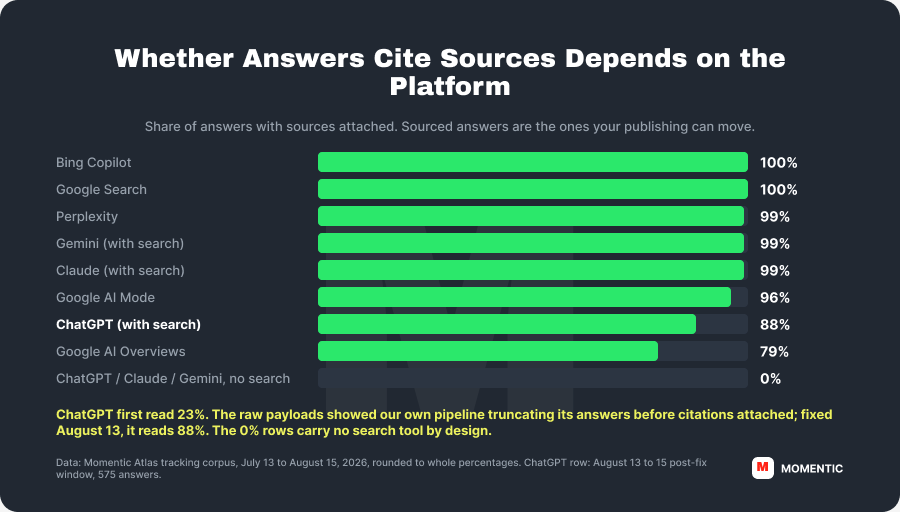
The citation data changes how to test prompts in two ways. First, whether an assistant searched says little on its own, because searching and citing are separate behaviors. Read which sources the answer cites. If a prompt's answers cite comparison pages, community threads, and editorial reviews, your brand could appear in those sources, and the prompt is worth tracking. If the answers cite nothing, or cite only encyclopedia-style pages, there is no citation for your brand to earn and no way to check what shaped the answer. Second, when one platform's rate falls far outside its band, check your own pipeline before you report it. Our ChatGPT outlier came from our own bug.
How to build the prompt set
Where the wording comes from. Your own content is a poor source for prompt wording, because it uses your internal vocabulary and buyers usually don't. Take phrasing from sales calls, onboarding calls, and support tickets, where prospects describe problems in their own words. Pull long queries from Search Console with the regex filter ([^" ]*\s){5,}, which matches queries of six or more words, over a 6 to 12 month window. Note where searchers' vocabulary differs from your website's. The prompts should use the searchers' words, and your content may need to as well. If your tracking tool records query fan out, review the searches assistants run behind answers in your category at the topic level, since the exact strings change between runs. Community threads add more buyer phrasing. Then rewrite each raw phrasing into the four parts: who is asking, their situation, the problem, and the request.
Testing before tracking. Run each candidate prompt several times on each platform you plan to track. Keep a prompt when its answers are consistently relevant, cite sources your brand could appear in, and mention options when the prompt asks for them. Rework or cut it when the answers are generic, unsourced, or inconsistent across runs. Because identical prompts disagree in about one repeat group in twenty, one clean answer proves little, and consistency across repeats is the standard to use.
Balance and fit. Classify each prompt's framing, balance the set so it nets to roughly zero, and confirm that each prompt makes sense for this specific business. The check takes about ten minutes and keeps prompt-set effects out of your headline findings.
Mix and size. Start with roughly 30 to 50 prompts: mostly full-context prompts that include a request, a few short category prompts, and brand prompts in their own group. Then adjust the mix with your demand data. If Search Console shows question-style queries growing in one product area, add prompts for that area. Pair each prompt with the page on your website that should answer it. A prompt with no matching page indicates a content gap to address before the prompt is worth tracking. With the pairings in place, the report becomes a list of pages to work on.
Cadence. Collect one to two weeks of baseline data before the first report. Review the set at two to four weeks with someone who knows the customers, because some prompts that tested well will fail in real tracking. Our own kick-off reviews have cut or reworked prompts every time. Refresh the set quarterly from new call transcripts, new long queries, and new query fan out data. A prompt set left unchanged for six months reflects what buyers asked six months ago.
The checklist
- Prompt wording comes from sales calls, support tickets, and Search Console long queries, in buyer vocabulary.
- Each prompt includes who is asking, their situation, the problem, and a request. Prompts meant to measure recommendations ask for a pick.
- Each prompt makes sense for the business it measures.
- Each prompt's framing is classified as negative, neutral, or positive, and the set nets to roughly zero.
- Each prompt was run several times per platform before tracking and judged on relevance, citations, options mentioned, and consistency.
- Brand prompts are grouped separately, checked for drops in mention rate, and kept out of the headline number.
- Each prompt is paired with the page that should answer it, or flagged as a content gap.
- A baseline window is set, a two-to-four-week review is scheduled, and a quarterly refresh is on the calendar.
The tracking tool matters less than the prompts it runs. Use prompts a buyer would send, balance their framing so it does not drive the findings, test them until their answers are consistent, and pair each one with a page you can change.
this text

