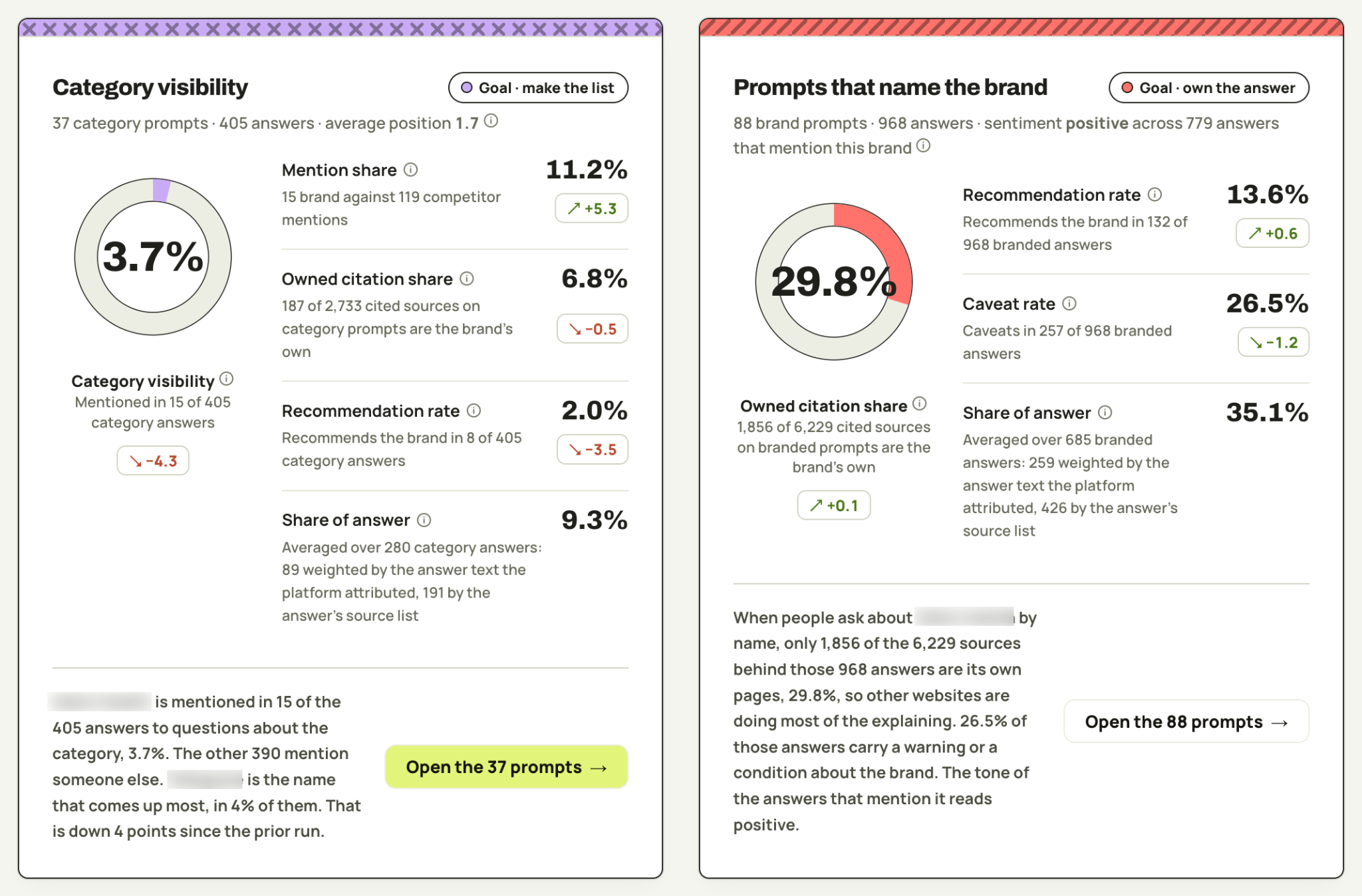
A client recently asked a good question about their Atlas prompt library: Why are there so many prompts that already include our brand name, and comparatively fewer discovery prompts?
In this specific case the ratio of non-branded to branded prompts was approximately 1:2, so it’s easy to understand their concern.
If the goal is understanding whether AI platforms are helping new people discover your brand, it can feel counterintuitive to track a lot of prompts that already name your brand. Because of course an LLM or AI answer engine is more likely to mention a company when the company is included in the prompt!
It’s not about “padding” the Atlas report to make it look like your brand is more visible in AI search than it actually is. Brand and non-brand prompts measure different things, and you need a healthy mix. If you want a robust set of meaningful ‘discovery prompts’ for your brand, we need your participation to build it.
Key takeaways:
- Branded, comparison and discovery prompts answer different questions. They should be evaluated separately, not blended into one AI visibility score.
- More discovery prompts aren’t automatically better. The goal is a representative prompt set tailored to the business, its audience and the insights it cares about.
- Client input makes discovery tracking better. Real customer questions, priority services, audiences, and off-limits topics help Atlas build prompts that reflect what the brand most wants to be found for.
- Your prompt library should evolve over time. Search behavior, AI responses and client feedback can all reveal where prompt coverage should expand, shift or be pruned.
Discovery is only one part of AI visibility
Atlas uses different types of prompts to answer different questions about how a brand appears in AI search.
A discovery prompt doesn’t name the brand. It might ask for a service, solution or recommendation that fits a particular need. The goal is understanding: Does our brand surface in relevant AI answers when it’s not named in the prompt?
Discovery prompts help us understand organic AI visibility.
Branded and comparison prompts serve a different purpose. They help answer questions like:
- What does an AI platform say when someone asks about our brand?
- What sources does it cite when answering questions about our brand?
- Is the framing positive, negative or neutral? (we keep the prompts deliberately neutral to better measure brand sentiment)
- How are we positioned against specific competitors?
- When someone asks an AI platform to choose between us and another option, which does it recommend?
These are important questions! They just don’t measure discovery.
Atlas keeps these prompt types and their measurements separate. A prompt that includes your brand name isn't used to inflate the visibility measurement for prompts where the brand had to surface organically.
What’s the “right” number of discovery prompts?
There isn't a universal best ratio of discovery to brand-inclusive prompts. More discovery prompts aren’t automatically better.
The goal is to track a representative set of questions that matter to the business, not to build the largest possible prompt library.
Quality over quantity is especially important with broad businesses, or brands still refining how they describe what they do.
We can and do use search data, website information and the follow-up searches (query fan-outs) AI platforms run while answering tracked prompts to identify meaningful prompts to track. But of course there are things a brand knows about itself and its audience much better than we do:
- Which services matter most?
- Who are the audiences the business most wants to reach?
- What problems bring those people to the business?
- What do prospects ask your customer service reps before deciding?
- Which competitors come up during the decision process?
- What does the business want to be more visible for?
- What topics does the business not want to be visible for, even if they’re accurate?
We can infer from experience and take our best guess at these answers for a given brand, and create a “full” discovery prompt library. But the data will be a lot more useful when the brand actively participates in selecting discovery prompts.
Better client input = better discovery prompts
This is why Atlas onboarding asks clients for more than a list of keywords.
We ask them to define their primary service lines and audiences, identify meaningful competitors and provide 15–30 questions buyers actually ask before choosing them.
Ideally, those questions come from real instances of prospect and customer language: sales calls, intake conversations, chat logs, support tickets, emails, form submissions, reviews, social listening, etc.
We combine those inputs with the data we already have to develop a more meaningful tracked prompt/question library in Atlas.
To be clear: we're not asking a client to sit down and “invent” 30 prompts for ChatGPT.
We're asking them to give us information we can’t get from Search Console or other tools: what your specific audience actually cares about and what the business most wants to compete for.
From there, Atlas can help turn that information into prompts that are relevant enough to measure and potentially act on.
Your prompt library isn't set in stone
Just like SEO/AEO strategy, Atlas isn’t “set it and forget it”. It’s meant to evolve as we learn more about a brand, its audience and how it shows up across AI platforms.
As we learn more about a company, its customers and which brands, sources and subtopics keep surfacing in AI answers, the tracked prompts can evolve with it.
That might look like expanding discovery coverage in an area the client identifies as strategically important. Or adding a previously unknown (or underestimated) competitor that keeps showing up in AI answers. Or deleting a prompt that looked useful initially but isn't leading to meaningful information.
The goal is always making the measurement increasingly representative of the questions the business needs answered, and this is best done with input from both sides.
We bring the search data, tracked AI answers, cited sources, and follow-up searches, plus the measurement framework and the ability to see patterns across platforms. Our clients bring context about customers, priorities and competitive realities that tools can’t fully infer.
If you want to see exactly how Atlas turns those inputs into tracked prompts (and how prompts are sourced, tested, balanced and reviewed), Tyler breaks down the prompt research methodology.
If you’d rather talk through what meaningful AI visibility measurement could look like for your business, get in touch with Momentic and bring us the questions you most need answered.